Years of travel, drawn as an atlas.
Roadbook reads the location history your phone already keeps — a Google Timeline export, or the geotagged photos on your camera roll — finds the journeys that stand out, and draws the ones you confirm as plates in an atlas. Its one rule: it never draws a line it cannot justify.
A LIFE MAP · THREE ADVENTURES · DEMONSTRATION TIMELINE
Fictional demonstration data, generated by committed code. Your atlas is drawn the same way, from your own history.
The honesty rule
Every line states its confidence
A journey is a list of legs, and every leg says how it is known. The distinction survives from the detector all the way to the pixels — it is the product's structure, not a styling choice.
Observed
Your phone's own recorded fixes. Measurement — never smoothed, never replaced.
Routed
A gap filled by road routing. Inference, and drawn as inference — cased in paper so it can never be mistaken for measurement.
Unknown
A gap nothing can honestly fill. A dashed straight line that says exactly that, instead of a guess.
Air
A flight, drawn as a dotted great-circle arc — never pretending to be a road.
A gap drawn as a confident solid line would be a lie. Most tools in this category draw one anyway; Roadbook is built so it cannot.
How it works
From an export to an atlas
-
Bring your data
A Timeline export made on your phone, or geotagged photos straight from your library. Your instance's front door carries per-platform walkthroughs; a wrong file is told apart and pointed the right way.
-
Candidates are detected
Journeys away from home with a real destination. Home is derived from your own data — nothing about you is configured or assumed.
-
You confirm what counts
Detection deliberately over-produces; choosing which journeys are adventures is yours. Nothing appears on your map unconfirmed.
-
Your life map and atlas
One map holding every confirmed route, and a plate for each adventure — its days, distances with their composition, countries, and photos.
The product
What you reach
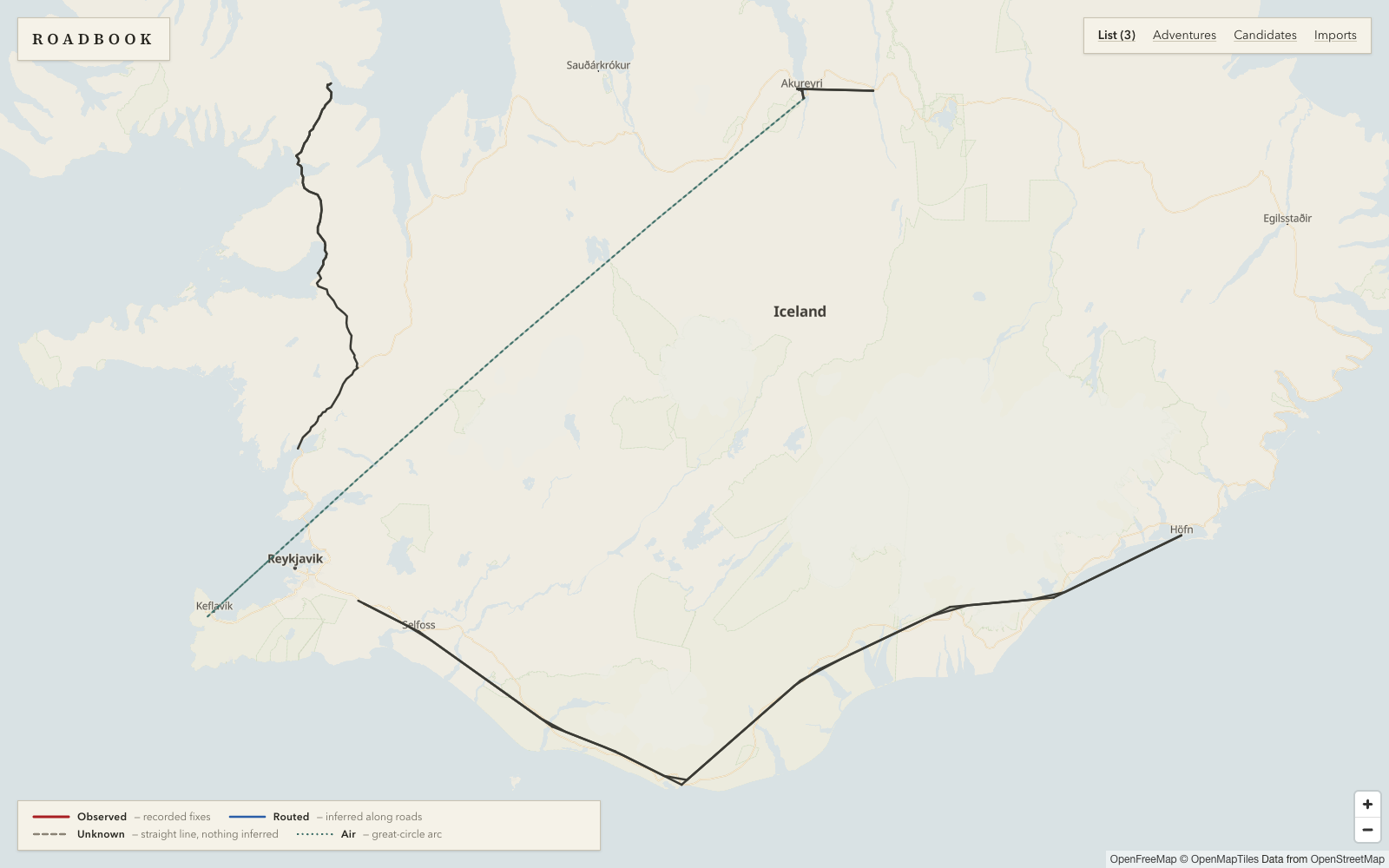
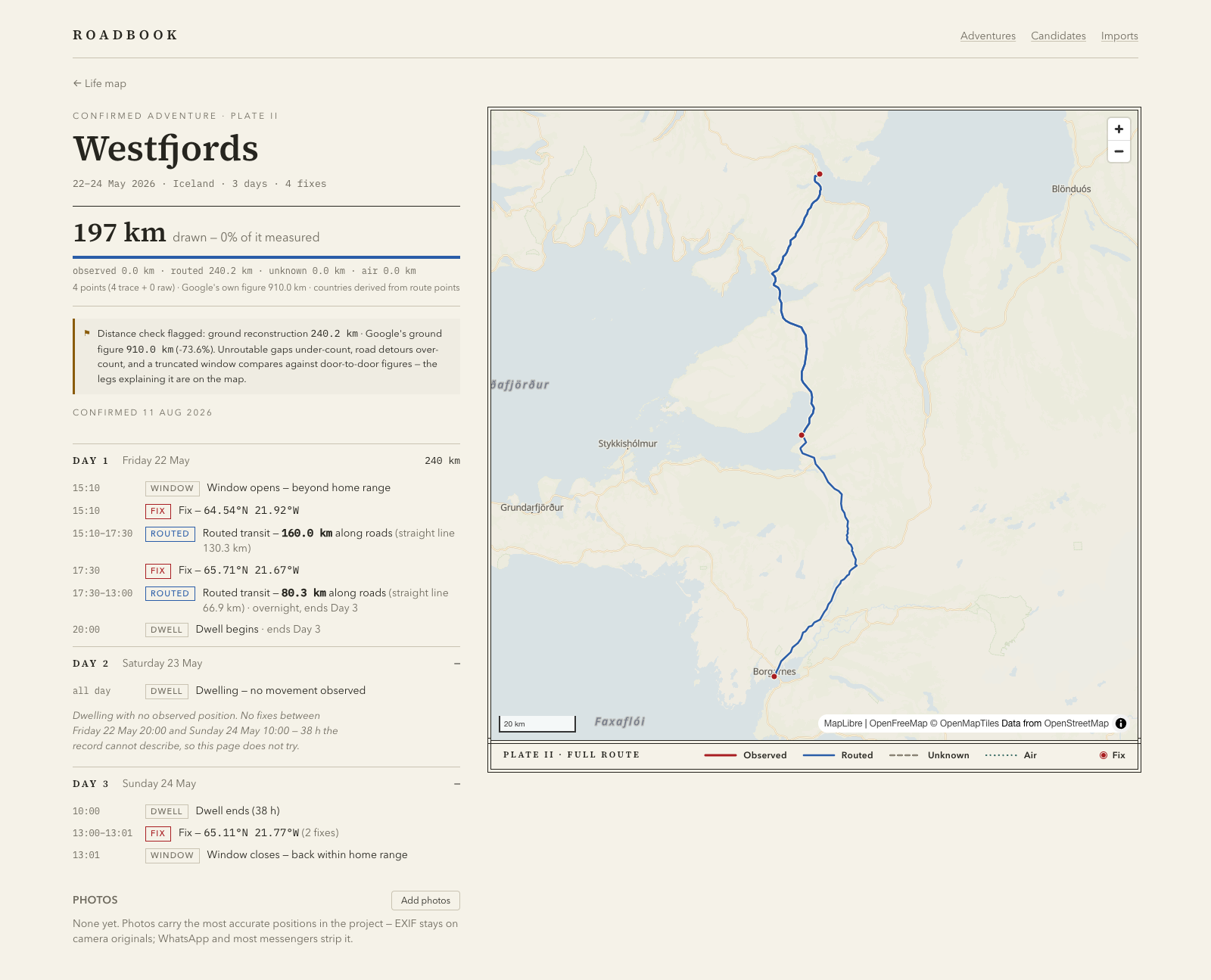
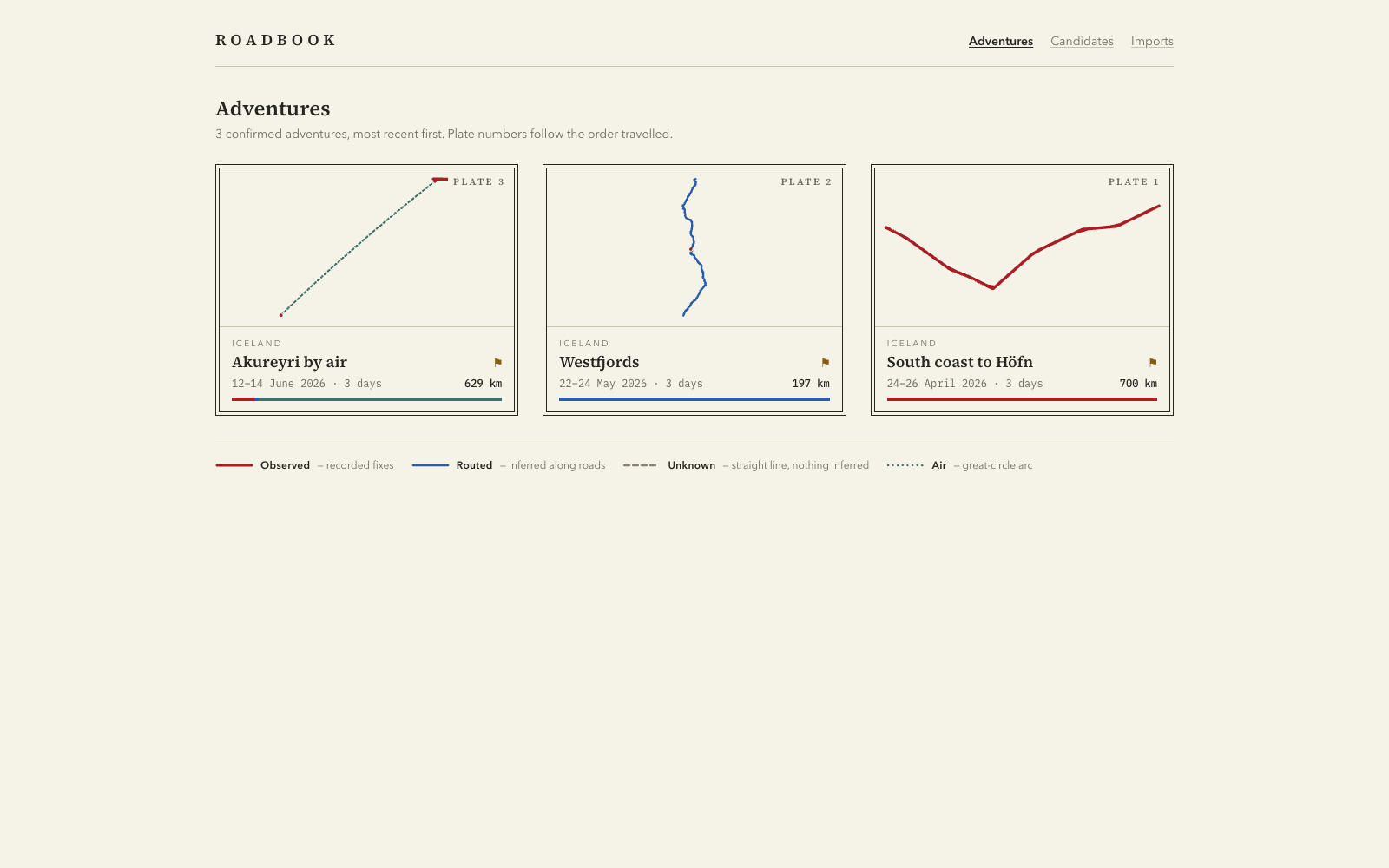
All three screens are captured from the demonstration dataset committed in the repository — every number in them reproduces from a command.
Custody
Where your data lives
- Your own instance, alone on it
- Hosted Roadbook is one full instance per person — your own database, your own credential, an unlisted address. Instances share nothing; there is no cross-user anything to go wrong.
- Uploads stay put
- Your export streams to your instance and nowhere else, and is retained there because it may be the only copy of your history that still exists. Photos are never kept — only their positions, times, and small thumbnails.
- Backed up, encrypted, off the host
- Nightly backups leave the server encrypted; the key never lives where the data does.
- Deletable, meaning it
- Leaving is one request: the instance and its backups are destroyed. Nothing lingers in a provider's analytics because there are none — this page itself carries no scripts, no cookies, no trackers.
There is no public try-it demo, on purpose: an open upload endpoint for strangers' location histories would be a custody problem dressed as a convenience. The screenshots above and the one-command demo in the repository are the substitute.
The way in
Ten slots, and a list
SLOTS · HAND-PROVISIONED · TEN
Roadbook is opening to its first ten people — each with their own private instance, set up personally. Want one of the slots? Leave your email and you're on the list.
Your address lands in one file on this host — no form service, no mailing-list provider. It is used for exactly one thing: an entry email with your private link and credential when a slot opens. Nothing else is ever sent, and if you ask, the line is deleted and you were never here.
Rather run it yourself? Roadbook is open source and self-hosting is
the reference deployment — the hosted service runs the same
docker compose up,
and the repository's README starts you with the demo dataset.